Monday, September 20, 2010

Week 1 of my life without a car

The first week of my Zipcar® Low Car Diet has come to an end, and so far, it has been quite a rewarding challenge. I have logged numerous miles via transit (bus and rail), pedestrian and carpool. MARTA has been the true champion as its Route 16 has twice come in handy: when I needed to get home from Emory University, and when I went from home to the Carter Center.
My feet have also carried me a long way. I have walked to bus stops, MARTA stations, home and even dinner. I must have logged more than 10 miles on foot alone.

Finally, I have to give props to all my colleagues and friends who have given me rides to meetings and appointments around town. I do my best to minimize these requests and certainly make every effort not to inconvenience anyone. One surprise of the week is that I have not needed a Zipcar. I guess I will continue to bank the credits for another week.

More about the Low Car Diet promotion in this AJC story.

Follow the progress of all Low Car Diet participants.

Tuesday, September 14, 2010

Giving up the auto fix

Well, today is the first day of my new diet, the "Low Car Diet," sponsored by Zipcar, the carsharing service. I pledged to give up my vehicle for 30 days and find other ways to meet my transportation needs.

I have been a Zipcar member (formerly Flexcar) since Lanier brought it to Atlanta four years ago. Until now, however, my personal car has been my primary mode of transportation, especially during the week. It seems when you have a car, you drive it, even if other options are available. It is like having a big piece of chocolate cake placed in front of you after every meal. You just eat it.

Well, no more. Starting today, I am giving up the automobile fix. At least for a month. I will keep you posted on how I do.

Wednesday, September 8, 2010

The Most Dangerous Pedestrian Cities in the World

What are the most dangerous cities in the world to walk in?

GOOD Magazine has come out with an excellent info graphic illustrating the world cities with the most pedestrian fatalities per 100,000 residents. Three American cities made the list: Detroit, Atlanta, and Los Angeles. Detroit and Atlanta had 10 per 100,000, and Los Angeles had 7.

The study source is the New York City Pedestrian Safety and Action Plan dated August 2010.

Thursday, August 26, 2010

You think you have it bad


When I was a kid and I did not finish my vegetables, my parents would always remind me of the poor children starving in other parts of the world. Well now, parents who have children who complain about how long it takes to drive somewhere can say, "You are lucky you are not a child stranded in the 60+ mile traffic jam in China."
It appears China's new love affair with the auto combined with truck traffic has resulted in a 10-day traffic jam that may span into September. The WSJ reports that businesses popped up along the route to take advantage of the captive audience, and law enforcement was out in force to quell the unrest.
We in the United States have never experienced such a thing, and I hope we never will, but we certainly have felt the negative impact of our own love affair with the car, and it has resulted in new thinking around the way we develop and move around. For example, we have embraced mixed use developments that support alternative forms of transportation. The Chinese have their own ideas, and you can read about them here.

Monday, August 16, 2010

The Economics of Paid Parking

Here at Lanier, it is no surprise that we support the concept of paid parking. However, that is not only because our business is built on managing paid parking operations. Placing a monetary value on the availability of parking is also good for the environment, congestion and urban planning.
A recent article by Tyler Cowen, a professor of economics at George Mason University, makes the economic case for more paid parking.
"Is this a serious economic issue? In fact, it is a classic tale of how subsidies, use restrictions, and price controls can steer an economy in wrong directions. Car owners may not want to hear this, but we have way too much free parking."
Cowen points out that zoning laws often mandate ample parking at businesses, effectively subsidizing car trips that the free market would have discouraged.
"If developers were allowed to face directly the high land costs of providing so much parking, the number of spaces would be a result of a careful economic calculation rather than a matter of satisfying a legal requirement. Parking would be scarcer, and more likely to have a price — or a higher one than it does now — and people would be more careful about when and where they drove."
Donald Shoup, professor of urban planning at UCLA, explains that 99% of all vehicular trips in the United States end up in free parking. Professor Shoup has been arguing for paid parking for the better part of a decade and has written a book that I have previously discussed called "The High Cost of Free Parking."

Thursday, July 29, 2010

"First ring" suburbs no longer fit for walking


Excellent video about pedestrian safety and the built environment, in particular the "first-ring" suburbs. The focus is on Buford Highway in Atlanta, but this could be any suburban community in the United States.

These first ring suburbs were built 30 to 40 years ago to accommodate the first wave of urbanites escaping the trappings of the inner cities, and they relied exclusively on the automobile to get around. Once hot growth spots, many of these communities have found themselves aging and declining, threatened by the pull of newer, farther out suburbs and gentrified inner cities.

The population of these communities is now made up of the low-income families (largely elderly and immigrants), many of whom cannot afford automobiles. Over the years, transit has been laid on top of these commuter corridors making them less safe. Kudos to organizations like PEDS and many others who are working tirelessly to make them less dangerous.

Wednesday, July 21, 2010

China adopting alternative transportation solutions to meet crushing demand

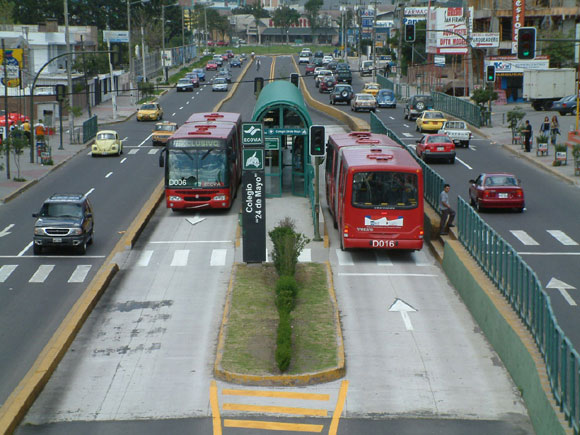
China is learning very quickly what it took the U.S. decades to realize. You can’t solve traffic problems only by building and widening roads. In a New York Times story this week, Chinese cities are using BRT (Bus Rapid Transit) systems with elevated stations and lanes dedicated to the buses. Interestingly, it was the U.S. based Institute for Transportation & Development Policy that suggested the idea to the southern Chinese city of Guanghhou.

"And they are not adopting necessarily the same model that the U.S. has adopted in trying to solve all their mobility needs through the construction of highways and increasing the capacity of their road network…” – said a transportation engineer.

Los Angeles runs a BRT system, and Seattle has a partial system. The Atlanta Regional Commission is planning a BRT system with dedicated lanes and light rail from the suburbs.