Tuesday, August 23, 2011

Will Car Drivers Fight Efforts to Make Transit Fashionable?


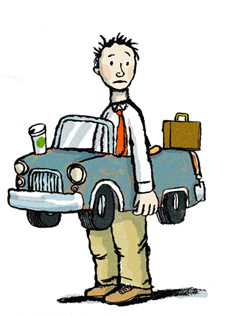
So, you're driving down the road and you spot a person traveling on foot, or perhaps a cyclist in business attire. Maybe someone waiting for the bus. What is your perception of that person? Do you feel sorry for them? Or are you irritated by their smug sense of superiority? Or both? Can you feel both of these things at the same time?

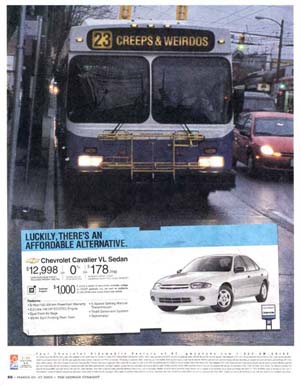
I'm reminded of a piece in Planetizen last December in which Brian Ladd describes how transit is appealing more to riders of choice, contradicting the belief, often reinforced by politicians, that public transit is for people who have no choice.
When a Los Angeles bus rider asked presidential candidate George W. Bush about transit improvements in 2000, Bush responded, "My hope is that you will be able to find good enough work so you'll be able to afford a car." Bush was undoubtedly sincere. Like many Americans—probably most—he saw a bus (like a bicycle) as a nothing more than a pathetic substitute for a car.
How we feel about people who use alternative forms of transportation affects policy and ultimately the resources we spend on them. Ladd worries that as alternative transportation becomes more fashionable, car drivers will adopt a bunker mentality and try to demonize policies that favor bikes, trains, and buses.

Just remember, for every person you see on foot, on a bike, or waiting for a bus, that represents one car that is NOT in your way.

Monday, August 8, 2011

What to Do About a Lack of Crosswalks: Prosecute Pedestrians?

The issue of providing safe crossing for pedestrians has been front and center ever since the national media took notice of the Raquel Nelson story in Atlanta. Ms. Nelson was convicted of vehicular homicide because her four-year-old son was hit and killed as the family crossed a four-lane road. There were no crosswalks nearby.

From Atlanta to Mumbai, the transportation infrastructure has deemed cars a far higher priority than pedestrians. The result is soaring pedestrian death rates.

The Times of India reports "nearly 78% of road fatalities are pedestrians," a result of the country's focus on widening roads to accommodate the surge in cars.

Policies in most American cities aren't that different, with transportation and transit planners' single purpose being to move as many cars through an area as fast as possible. The solution isn't how to eliminate the cars but how to slow them down to accommodate other modes.

Ben Welle, assistant project manager of Health and Road Safety at EMBARQ, says “The thing to remember is that the one thing that is always involved in a car crash is a car, so slowing them down through good design and shifting trips through high quality mass transit, walking and biking facilities can really reduce risk.”

To read more about Raquel Nelson's story and the issues they have raised check out the following links:
Pedestrian Infrastructure Essential to Safer Roads Worldwide - The CityFIX

Georgia Mom Convicted of Vehicular Homicide For Crossing Street With Kids

Prosecuting the Victim, Absolving the Perpetrators

Tuesday, July 19, 2011

Collier's Parking Rate Survey and Results for 2011

The results of Colliers International's 2011 Parking Rate Survey are in for the U.S., Canada, and the rest of the world.

The U.S. national median monthly parking rate is $155.22, with the highest being midtown Manhattan at $541. Reno, Nevada is the cheapest at $45. In Canada, Calgary topped out at $486 followed by Toronto at $342 and Montreal at $305.

Globally, the most expensive cities to park in are London at an average of $1,084 a month, Zurich at $822, Rome at $719, Hong Kong at $745, Tokyo at $744 and Perth, Australia at $717.

When compared with previous years, it appears despite the strengthening economy owners and operators are holding the line on parking rates. There was little change from 2010. In the U.S., medium monthly parking rates have dropped 0.2% since 2010, and most cities were found to have between "fair" and "limited" parking, with few exceptions.

Check out the study here.

Friday, July 8, 2011

The State of the American Highway System


Over the past few years we have been hearing a lot about the nation's failing infrastructure and how we can not afford to maintain or rebuild it. Well, Zach Rosenberg of "Car and Driver Magazine," paints a very bleak picture of our broken highway system and the challenges to fixing it in, "The State of the Union's Roads: An Investigative Report."
Zach explains that the Interstate Highway System, which is the backbone of the United States four million miles of roads, has reached the end of its useful life. Designed to last only 20-30 years, these roads are pushing 50 years old, and there just isn't the political will and/or the money to replace them.

Rosenberg gives a brief history of the highway system, its funding, and how its role has changed and been used far beyond its capacity. One example Rosenberg cites is the Tampense bridge in New York City, which was designed to handle 18,000 cars a day. It now carries 150,000.

"This is the era of the worn-out highway, of the traffic jam, of endless commutes, of road rage. Beltways and bypasses will not help you. We demand more, far more, than the interstates were built to withstand."

Not a pretty picture.

Tuesday, June 14, 2011

New Service Tracks Shuttle Buses in Real Time


Lanier Parking Solutions is more than an innovator in the parking industry. We are an innovator in the transportation field. Last week, Lanier Parking Solutions in partnership with Atlantic Station and TransLoc launched a real-time shuttle bus locator at Atlantic Station. You can go on-line and see the two hybrid electric buses moving along the route.

"This technology has allowed Lanier to get greater efficiency out of the vehicles, helping customers and saving the client money," explained Steven Taff, Lanier's Atlanta GM.

Check it out here or download the smartphone app online.

Saturday, May 28, 2011

Is Your Commute Killing You?


This week, researchers at Umea University in Sweden released a startling finding that suggests people with longer commutes suffer disproportionate pain, stress, obesity, and dissatisfaction. So why do they do it? Often, it is to get more house for the money. But they fail to take into account the real cost and time spent commuting.

This study indicates the real cost goes well beyond the gas in your car.

Friday, May 20, 2011

Parking Made Simple Via New Application


It was only a matter of time before technology eliminated many of the hassles associated with parking. A new app called "Parking" makes it easy to find a spot, pay for it, and even find your car when you return. Streetline, a California start-up, is the maker.
From GreentechEnterprise: The idea of finding a spot more easily, and collecting data about them, is appealing to drivers, merchants and cities alike. "Parking is a great unsolved problem," said Zia Yusuf, CEO of Streetline. He pointed to a study from UCLA that found that in just one 15-block area of Los Angeles, about 30 percent of traffic involved people looking for parking, a figure that added up to nearly one million excess vehicle miles in a year in that small areas.
It appears the opportunities are limitless for Parker, which can also find Zipcars, handicap spaces, and electric charging stations.

Check out the full story

Download the app